

History of the Department of Morphological Disciplines
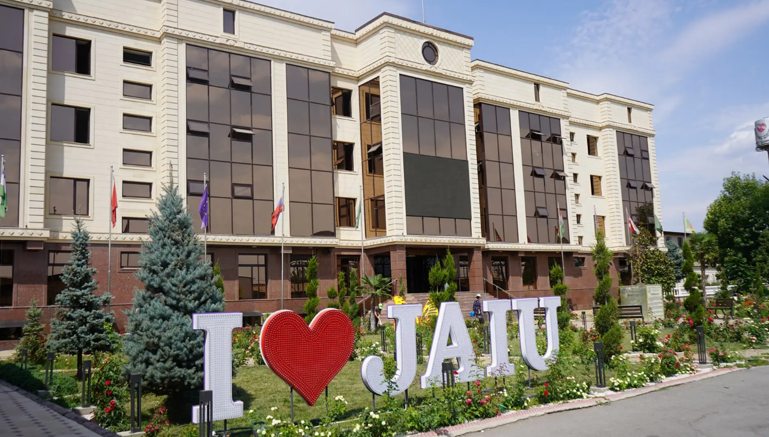
Faculty of Medicine of Jalal-Abad International University (JAIU)
The Department of Morphological Disciplines is one of the leading academic and research institutions within the Faculty of Medicine at Jalal-Abad International University. Its establishment marked an important milestone in the development of medical education in the region and the formation of a modern model for training future specialists.
Development Stage
Jalal-Abad International University was founded on September 1, 2024.
It was during this period that the first basic structure of the medical faculty was created — the Department of General Medical Disciplines.
Development Stage
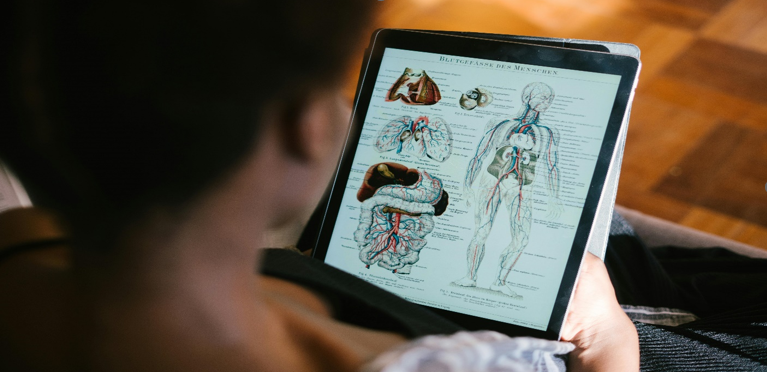
The department taught fundamental subjects that form the basis of medical thinking:
human anatomy,
-
biology
-
pathological physiology
-
pathological anatomy
-
therapy
-
pediatrics
-
hematology
-
endocrinology
-
propaedeutics of pediatrics
-
physiotherapy
-
evidence-based medicine
and a number of other subjects that create a strong foundation for future doctors.
Formation of independent departments
With the development of the faculty and the growing number of students, there arose a need for deeper specialization and division of directions.
On September 1, 2025, two independent departments were established at the JAIU medical faculty:
• the Department of Morphological Disciplines,
• the Department of Clinical Disciplines.
The initiator and scientific supervisor of the reorganization was the Candidate of Medical Sciences Nurgul Adylgazievna Sadyrova, who played an important role in shaping the faculty’s academic traditions and in developing scientific and methodological work.
The Department of Morphological Disciplines today
The department is headed by Candidate of Medical Sciences Kanibek Matsakov.
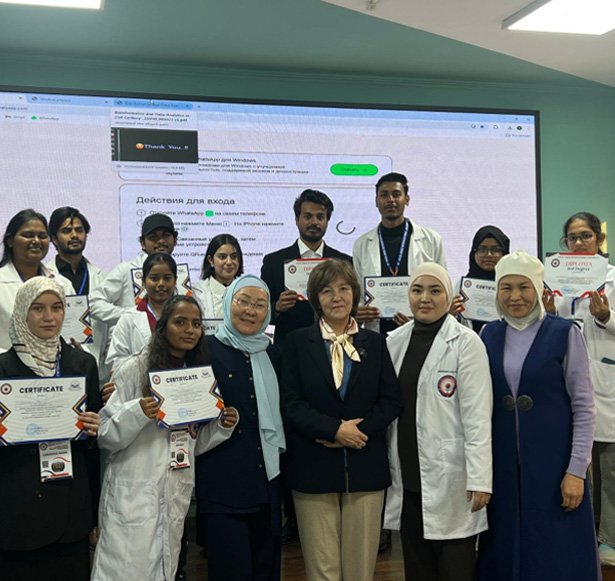
Under his leadership, the team actively develops educational and methodological activities, implementing modern educational technologies and digital solutions in the teaching of morphological disciplines.
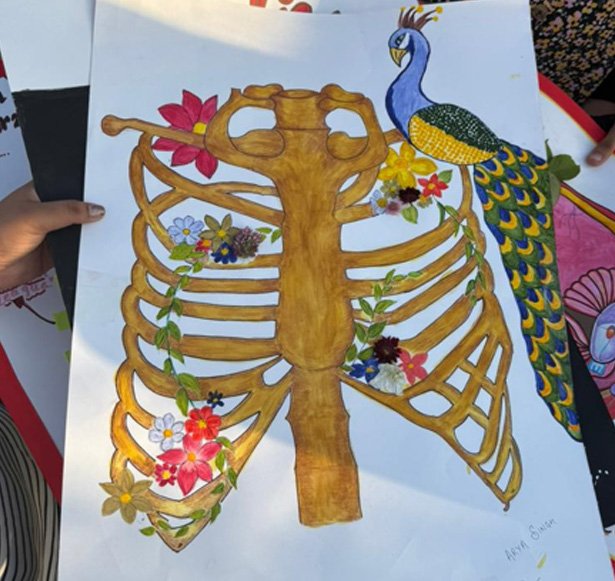
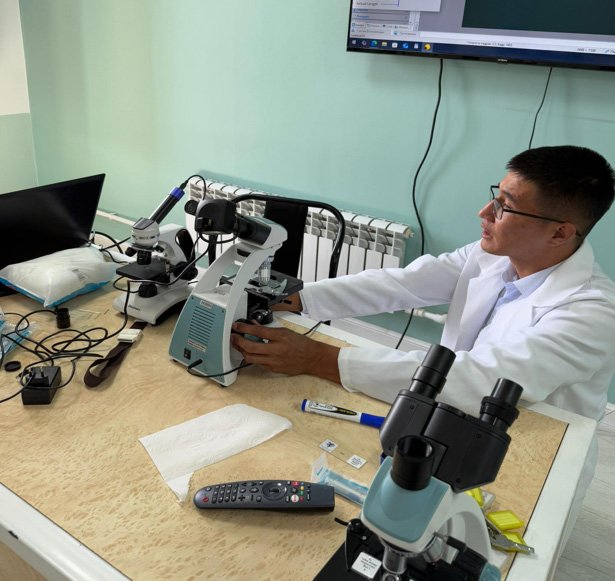
The main goal of the department is to ensure high-quality training of students in fundamental medical fields.
Disciplines taught at the Department of Morphological Sciences
Normal and topographic anatomy — the study of the structure of the human body, its organs, systems, and their spatial relationships.
Histology, cytology, and parasitology — the science of tissues, their structure, and their functions.
Microbiology — the study of the cellular organization of living systems, processes of cell division, and cellular activity.
Pathological anatomy and physiology — the study of morphological and functional changes occurring in various diseases.
Biology and the fundamentals of medical genetics — understanding the biological basis of life, heredity, and the genetic mechanisms of diseases.
Normal and clinical biochemistry.
Latin language
Each of these disciplines forms a solid foundation of knowledge for future doctors, develops clinical thinking, and helps students understand the deep processes that occur within the human body.
The teaching staff of the department combines experience and youth, tradition and innovation. Every instructor strives not only to transmit knowledge but also to develop clinical thinking, scientific interest, and professional responsibility in students.
Development prospects
The Department of Morphological Sciences at JAIU is actively developing and sets ambitious goals.
Upcoming plans include establishing a laboratory for microscopic research, developing virtual anatomical modules, implementing digital educational platforms, and expanding students’ scientific research activities.
Special attention is given to forming student scientific circles, supporting young researchers in attending conferences, and encouraging the publication of scientific articles. The department actively cooperates with other university units, aiming for the integration of science, practice, and education.
The Department of Morphological Sciences is not just an academic unit — it is the foundation upon which the medical profession is built, a place where future doctors take their first steps into the science of the human body.
The Department of Morphological Disciplines is more than just an academic department; it is the foundation upon which the medical profession is built, a place where future doctors take their first steps into the science of human development.
Staff of the Department of Morphological Disciplines
Faculty Members:
• Orozbekova Bubusaira Tolobekovna — Associate Professor of Medical Sciences, Professor
• Muhammad Shoaib Shahid N — PhD
• Sakbaeva Zulfiya Israilovna — Professor
• Ernazarova Baktygul Kochkorbaevna — Professor
• Chaulagein Dipak — PhD
• Temirov Nemat Moydunovich — Candidate of Medical Sciences, Associate Professor
• Ahmedov Erlanbek — PhD
• Zhunusov David Nurlanbekovich — Assistant Lecturer
• Akramzhanov Akmal Tajidinovich — Assistant Lecturer
• Sadykov Askat Adylbekovich — Lecturer
• Taalaybek kyzy Aida — Lecturer
• Arzykylova Ajnagul — Lecturer
• Bektemirov Zhantoro — Assistant Lecturer
• Dzhoraev Farkhod — Assistant Lecturer
• Zheenbaeva Aiperi Boronbaevna — Lecturer
• Ikramzhan kyzy Makhlie — Assistant Lecturer
• Kochorova Mayram — Lecturer
• Murugappan V.K — Assistant Lecturer
• Shergazieva Aiday Azizbekovna — Assistant Lecturer
• Tazhibaeva Aisuluu — Lecturer
Each staff member of the department is not only a teacher but also a mentor who helps students explore the complexities of the human body's structure and develop the essential professional qualities of a physician. качества врача.
Atmosphere and students

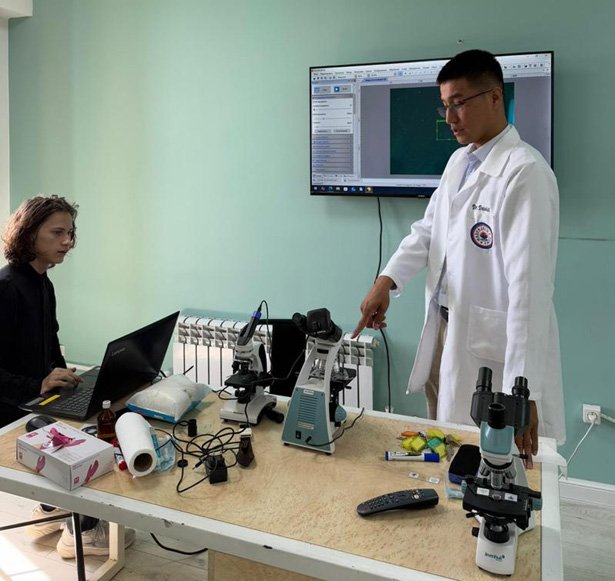
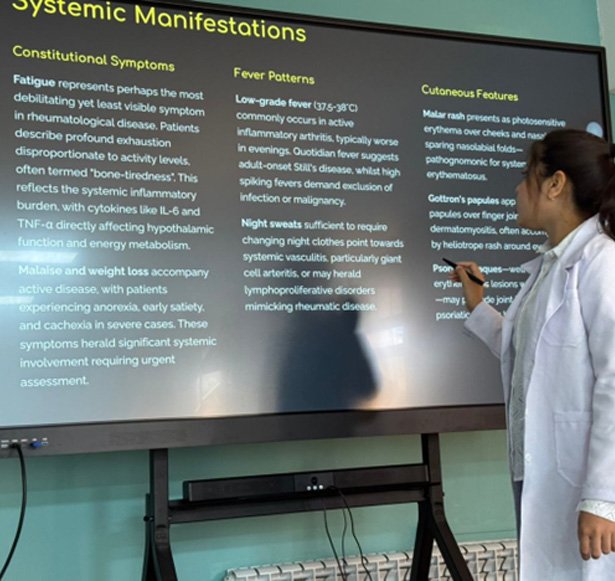
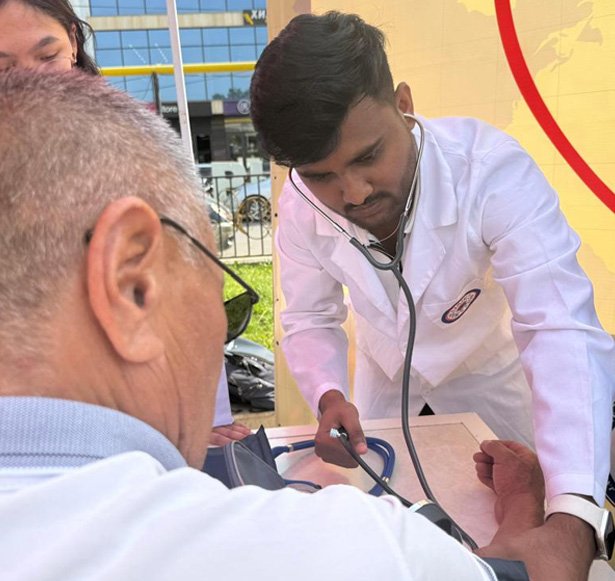
A practical lesson in anatomy. Laying the foundation for future medicine.
The Department of Morphological Disciplines at JAIU is a space of knowledge, inspiration, and scientific inquiry, where the traditions of medical education and modern innovations merge.